
Injector Matching – Understanding the Process and Its Variables
What Injector Matching Means
Injector matching is the process of comparing and grouping fuel injectors to ensure they deliver fuel as consistently as possible across all cylinders. In high-performance and motorsport engines, balanced fuel delivery is essential for power consistency, efficiency, and reliability.
Matching does not make injectors identical — rather, it helps identify how similar their behavior is under controlled test conditions.
Why Injector Test Results Differ
Different injector test benches often produce different results, even for the same injectors. This variation is completely normal and depends on several factors:
-
Testing Equipment: No two injector testers are exactly the same. Differences in hardware, calibration, and software can cause variations in flow readings.
-
Voltage Supply: The voltage applied to the injectors during testing influences how the solenoid behaves. Lower or unstable voltage can lead to slightly slower injector response times.
-
Test Fluid Properties: Different fluids have varying densities, viscosities, and lubricating properties, all of which can affect flow rate readings.
-
Temperature: Both fluid and ambient temperature impact viscosity and injector performance during testing.
-
Pressure Differences: The fuel pressure at which injectors are tested directly affects their flow rate. Even small pressure variations can change the measured flow significantly. For example, a 3-bar vs. 4-bar test pressure can alter flow results by over 15%. Therefore, when comparing data, always ensure that injectors are tested at the same reference pressure.
Because of these factors, matching results from different machines are not directly comparable — only relative consistency within the same test setup is meaningful.
Injector Run-In and Stabilization
Brand-new injectors often need a run-in period before they achieve consistent performance. Each injector’s internal components (like the needle, seat, and seals) settle differently with initial use, meaning their flow characteristics can change slightly over time.
During this run-in phase:
-
Some injectors stabilize faster than others.
-
The first few tests may show larger variations until all injectors “settle.”
-
Matching is most accurate after this stabilization process.
Static vs Dynamic Testing
Static Testing
Static testing measures the injector’s flow rate when it is held fully open for a fixed amount of time (e.g., 30 seconds). This gives a total flow volume measurement, typically expressed in cc/min or lbs/hr at a specified pressure.
Advantages:
-
Simple, repeatable measurement.
-
Useful for identifying large differences between injectors.
-
Good for basic flow verification or sizing comparisons.
Limitations:
-
Does not represent real engine conditions, where injectors are constantly pulsed on and off.
-
Overlooks variations in response time and closing behavior that affect performance during actual operation.
-
Highly sensitive to test pressure, so comparisons are only valid at the same reference pressure.
Dynamic Testing
Dynamic testing simulates real-world engine conditions by rapidly pulsing the injectors — for example, at varying pulse widths and frequencies that represent idle, cruise, or full-load scenarios.
Advantages:
-
Reflects actual performance in an engine.
-
Identifies differences in opening and closing times (known as dead time or latency).
-
Allows for evaluation of injector response, spray quality, and repeatability under realistic operating conditions.
Limitations:
-
More complex and time-consuming than static testing.
-
Results can vary depending on pulse settings, voltage, and fluid temperature.
-
Pressure stability during dynamic testing is critical — fluctuating pressure can distort measured flow.
Why Both Tests Matter
Static testing gives a baseline for total flow capacity, while dynamic testing reveals how consistent the injectors behave under real engine-like conditions.
A well-matched set of injectors should:
-
Have similar static flow rates, and
-
Exhibit minimal variation in dynamic response and pulse consistency.
Combining both methods provides the most accurate and practical evaluation of injector performance.
Additional Factors That Influence Injector Behavior
Beyond the testing equipment and setup, several system-related factors also influence how injectors perform and how consistent results will be between tests or in real-world operation:
-
Inner Diameter of the Fuel Rail:
The internal diameter of the fuel rail (spridarbrygga) affects flow stability and pressure recovery, especially under dynamic conditions. A smaller diameter can cause uneven distribution or pressure drops between cylinders. -
Use of Pulsation Dampers:
Whether a pulse damper is used or not — and the type of damper — significantly affects pressure stability.-
Large vs. small diaphragm area changes damping efficiency.
-
Material (rubber, silicone, metal) and the inner hole diameter of the damper also play a role in how pressure waves are absorbed or reflected in the rail.
-
-
Fuel Pressure Regulator Design:
The type of regulator influences how well the system maintains constant pressure.-
Membrane shape, material, and spring design can affect response and stability.
-
Regulators with or without vacuum reference behave differently, especially during transient conditions.
-
-
Injector Duty Cycle and Frequency:
Higher duty cycles (injectors open longer) can generate more heat and mechanical stress, affecting flow repeatability. At very short pulse widths (low duty cycle), differences in latency and response time become more noticeable. -
Fuel Pressure (High or Low):
Low pressure reduces atomization and consistency, while very high pressure increases mechanical load and potential flow nonlinearity. Testing and matching should always be performed at the same target pressure as the intended application.
For Those With High Accuracy Requirements
For customers with very strict matching tolerances, it can be beneficial to order two complete sets of injectors. This allows for testing both sets and returning the injectors that are not selected for final use.
⚠️ Important:
This must be agreed upon before purchase to ensure proper handling and documentation.
Pressure and Flow Relationship
Fuel injectors are typically rated at a specific pressure, commonly 3 bar (43.5 psi). Flow rate increases with pressure, following the square-root relationship:
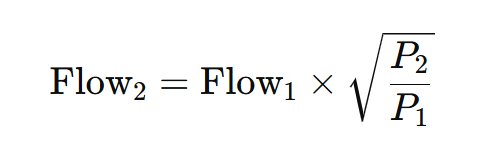
For example, if an injector flows 1000 cc/min at 3 bar, it will flow approximately 1155 cc/min at 4 bar.
However, in practice, not all injectors scale perfectly due to mechanical limits and internal flow restrictions. Therefore, actual flow scaling should be confirmed through testing — not just calculated.
Practical Takeaways
-
Use results from a single, consistent test setup for comparison.
-
Always note test voltage, pressure, fluid type, and temperature when evaluating results.
-
Consider system design factors such as fuel rail diameter, dampers, and regulator type.
-
Allow injectors to run in properly before performing final matching.
-
Understand that matching reflects consistency, not absolute flow rate accuracy.
-
Consider both static and dynamic data when assessing injectors.
-
For tuning purposes, the relative differences between injectors in the same set are what matter most.
-
If high accuracy is required, order double sets and perform comparative testing before final selection.
Conclusion
Injector matching is a valuable quality-control step for anyone building or tuning performance engines. By understanding all variables — including equipment, voltage, pressure, system design, and testing methods — you can ensure precise fuel delivery and improved engine performance.
Consistency is key: always test under controlled, repeatable conditions and compare injectors within the same setup.