
Relay - Information
1. What is a relay?
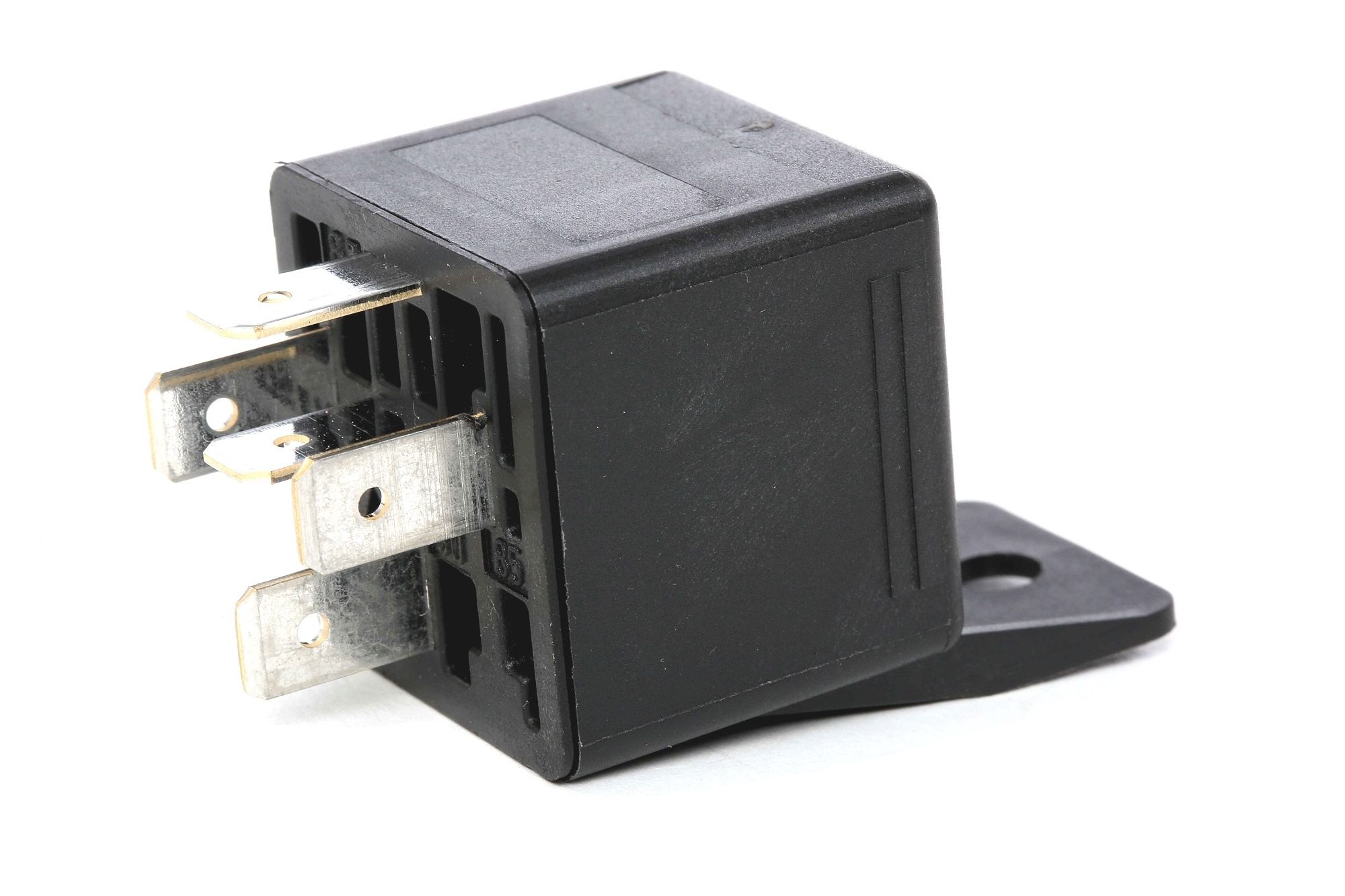
A relay is an electrically controlled switch that lets a small control signal turn on or off a larger electrical load.
In cars, it allows thin control wires or an ECU output to safely activate components that draw higher current, such as fans, fuel pumps, or headlights.
2. What voltage do automotive relays use?
Most modern vehicles use 12-volt relays, while trucks and heavy equipment often use 24-volt versions.
Some classic cars may still use 6-volt systems. Always match the relay voltage to your vehicle’s electrical system.
3. What types of relays are used in cars?
Common types include:
-
Standard (Pull-in) Relay – switches a single circuit on or off.
-
Changeover Relay – switches between two outputs (often called a 5-pin relay).
-
Starter Relay – controls the high current needed for the starter motor.
-
Turn Signal Relay – controls the blinking of the indicator lights.
-
Double Relay – two relays in one housing, often used for twin functions.
-
Solid-State Relay (SSR) – electronic relay with no moving parts, used in motorsport and high-performance setups.
4. What is a Pull-in Relay (4-pin relay)?
A pull-in relay has a coil inside that “pulls in” a contact arm when power is applied.
It can be Normally Open (NO) or Normally Closed (NC) depending on how it’s designed.
-
Normally Open (NO): The circuit is open when off. When you apply power to the coil, the contacts close, and current flows to the load.
→ Example: fuel pump, fan, lights, or horn.Control off → Load off
Control on → Load on -
Normally Closed (NC): The circuit is closed when off. When you apply power to the coil, the contacts open, cutting power to the load.
→ Example: safety cutoffs or alarm systems.Control off → Load on
Control on → Load off
5. What is a Changeover Relay (5-pin relay)?
A changeover relay has one input and two outputs — one Normally Open (87) and one Normally Closed (87a).
When the relay is off, pin 30 is connected to 87a.
When it’s energized, pin 30 switches to 87.
This type is used when you want to switch between two circuits, for example:
-
Switching between low and high beam
-
Controlling two fan speeds
-
Changing between two power sources
6. What is the difference between NO and NC in a relay?
-
NO (Normally Open): Power flows only when the relay is activated. Used for components that should be off until turned on.
-
NC (Normally Closed): Power flows until the relay is activated. Used for components that should be on until switched off.
| Type | Coil OFF | Coil ON | Typical Use |
|---|---|---|---|
| NO | Open – no current | Closed – current flows | Lights, horn, fuel pump |
| NC | Closed – current flows | Open – no current | Safety or cutoff circuits |
| Changeover | 30–87a connected | 30–87 connected | Dual-speed fan, beam switch |
7. What is the difference between a Diode and Resistor Relay?
When a relay turns off, it can send a small voltage spike back into the control circuit.
To prevent this, some relays have built-in protection — either a diode or a resistor.
-
Diode Relay:
Has a diode across the coil that completely blocks the voltage spike.
Must be wired the right way — pin 85 is ground (–), pin 86 is +12V.
Great for ECU-controlled circuits, but polarity sensitive. -
Resistor Relay:
Uses a resistor instead of a diode to reduce the spike.
Not polarity sensitive — can be installed either way.
Works well for switches, lights, or general accessories.
Simple summary:
| Type | Polarity Sensitive | Best For | Notes |
|---|---|---|---|
| Diode Relay | Yes | ECU and electronic control circuits | Must connect correctly (+ / –) |
| Resistor Relay | No | General accessories and lights | Easier to install |
| No Suppression | No | Older systems | Not recommended for modern cars |
8. How do I know which relay I have?
Check the diagram printed on the relay body.
You’ll see the pin numbers (30, 85, 86, 87, and sometimes 87a) and a small symbol showing the contact layout.
Relays often also have markings like “12V 40A” or a diode/resistor symbol.
9. What do the pin numbers mean? (Relay Wiring)
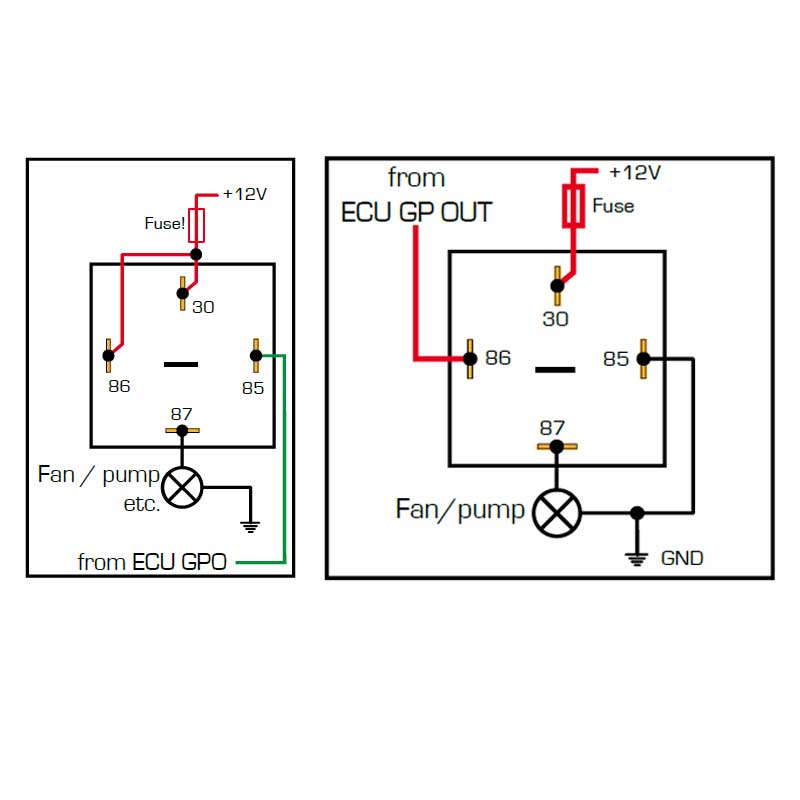
These are standard according to DIN 72552:
-
30 = Battery or power input
-
87 = Output to load
-
87a = Second output (only on changeover relays)
-
85 = Coil ground
-
86 = Coil power (+12V)
10. What amperage can a relay handle?
Most standard automotive relays handle 30–40 amps.
Heavy-duty relays can handle 60A or more, while small micro-relays are often rated for 10–20A.
Always choose a relay with a higher amp rating than your expected load for safety.
Example:
-
10A load → 15A relay
-
20A load → 30A relay
11. Do I need a fuse with a relay?
Yes — always use a fuse on the power supply (pin 30).
The fuse protects the circuit if there’s a short or wiring fault.
The fuse rating should be slightly higher than the expected load current.
Example:
-
10A load → 15A fuse
-
30A load → 35A fuse
12. How do I test a relay?
-
Listen for a click when you activate the circuit (switch, ECU, etc.).
-
Measure resistance between pins 85 and 86 — you should see around 50–200 ohms.
-
Apply 12V to 85 and 86 and check if 30 and 87 close.
-
Use a test light or multimeter to confirm continuity.
13. Can I test a relay while it’s still in the car?
Yes — but it’s less accurate.
You can listen for the “click” when the circuit is turned on, but for proper testing, remove the relay and check it with a multimeter or relay tester.
14. What are common signs of a bad relay?
-
No click when energized
-
Burned or melted housing
-
Corroded or loose pins
-
Load doesn’t activate even when relay is powered
-
Works sometimes, fails randomly
15. Why do relays fail?
-
Overloaded circuit (too much current)
-
Loose or corroded connections
-
Vibration or moisture damage
-
Continuous high temperature near the relay
-
Poor quality or worn contacts after long use
16. How often should I replace relays?
Relays can last for many years, but those used for high-current or critical functions (like the fuel pump or cooling fan) should be checked during major services.
Replace any relay showing signs of wear or intermittent operation.
17. Can I replace one relay type with another?
Yes, but only if it matches:
-
The same pin configuration (4-pin or 5-pin)
-
The same coil voltage (12V for cars)
-
An equal or higher amp rating
-
The correct suppression type (diode or resistor)
If you’re unsure, a resistor-type relay is safest for general automotive use.
18. How can I quickly find a faulty relay in the car?
Swap the suspect relay with another identical one from a non-critical circuit — for example, swap the horn relay with the fan relay.
If the problem moves, the relay is faulty.
Always mark or label relays during testing to avoid mix-ups.
19. What is a remote-controlled relay?
A remote-controlled relay works just like a regular relay, but instead of using a physical switch or ECU output, it’s activated wirelessly — for example, through a remote control, Bluetooth, or a key fob signal.
In simple terms, it lets you turn something on or off from a distance without running a control wire to the switch.
How it works:
-
The relay has a built-in receiver module.
-
When you press a button on the remote, the receiver energizes the relay coil inside the unit.
-
That closes (or opens) the circuit, just like a normal relay.
Typical uses:
-
Turning on auxiliary lights or work lamps remotely
-
Operating winches or air compressors
-
Controlling fuel pumps or cooling fans on race cars
-
Remote power cut-off systems
Simple explanation:
A remote-controlled relay is a wireless switch that uses a relay to handle the high current — it’s the same concept as a normal relay, just controlled without wires.
20. What’s the simplest way to explain how a relay works?
You can think of a relay like a remote-controlled switch.
The small control side (pins 85 and 86) uses very little power but can switch a large power side (pins 30 and 87) on and off — safely handling higher current than a normal switch could.